How it changed
Eight chapters that made the chapels
The complex took more than 300 years to build. Wars, murders, a failed plan to obtain a holy relic and the end of a dynasty all left their mark.
011519–1527
Michelangelo’s first building
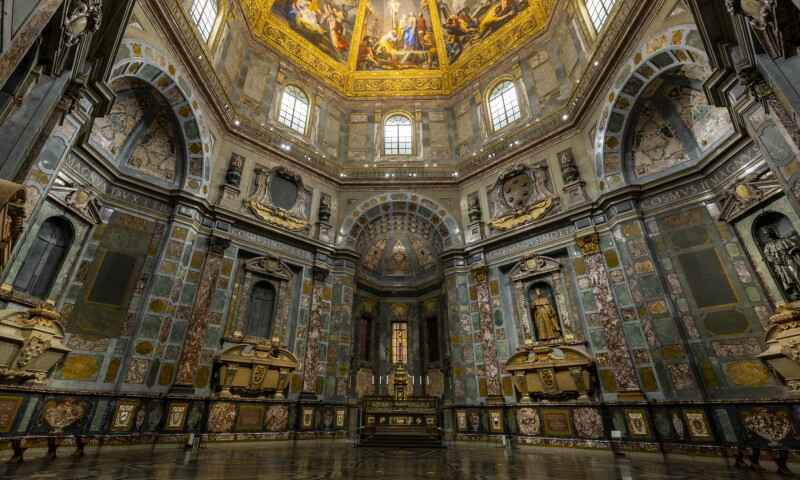
The New Sacristy was Michelangelo’s first architectural project. He designed the walls, doors, windows and tombs as one system, and the dome was vaulted by 1524. Early drawings show he first planned a free-standing tomb in the middle of the room.
What remainsThe wall tombs we see today replaced that first, larger idea.
021527–1530
The sculptor in a rebel city
In 1527 the Medici were expelled from Florence and the Republic restored. Michelangelo sided with the Republic and was put in charge of the city’s fortifications during the siege of 1529–1530. After the Medici returned, he is thought to have hidden for some time in a small room beneath the sacristy.
Twist of historyHe hid from the family whose tombs he was carving.
031534
Michelangelo leaves for good
Michelangelo left for Rome in 1534 and never returned to Florence. Statues lay unfinished on the sacristy floor. Some figures, including Day, still show the rough marks of his claw chisel.
Unfinished on purpose?Whether the “non-finito” faces were deliberate is still debated.
041537
A murdered duke in his father’s tomb
Alessandro de’ Medici, first Duke of Florence and presumed son of Lorenzo, Duke of Urbino, was assassinated by his cousin Lorenzino in 1537. His body was placed hastily in his father’s sarcophagus in the New Sacristy.
Nearly 500 years laterStains from his poorly embalmed body were among the marks restorers removed in 2019–2020.
051545–1555
Others finish Michelangelo’s room
Under Duke Cosimo I, Niccolò Tribolo installed the statues in 1545. Giorgio Vasari and Bartolomeo Ammannati completed the room by 1555, with Montorsoli and Raffaello da Montelupo carving the saints beside the Madonna.
Remote controlMichelangelo advised from Rome, but the final arrangement was not entirely his.
061588
A workshop founded for one chapel
Grand Duke Ferdinando I founded the grand-ducal hardstone workshop, today’s Opificio delle Pietre Dure, partly to produce the inlays for a new family mausoleum. Its craftsmen spent generations cutting stone for it.
Still workingThe Opificio is now one of Italy’s leading restoration institutes.
071604–1640s
A tomb built for the Holy Sepulchre
Cosimo I had dreamed of a grand mausoleum, and Ferdinando I began it in 1604, with Matteo Nigetti directing work from a design by Don Giovanni de’ Medici. The centre was meant to hold Christ’s tomb from Jerusalem. Attempts to buy or remove it failed, so the space stayed empty.
Visitor takeawayThe bare centre of the octagon is where the relic was meant to stand.
081737–1743
The last Medici and the Family Pact
Gian Gastone died in 1737 without an heir, and Tuscany passed to the House of Lorraine. His sister, Anna Maria Luisa, signed the Family Pact that kept the Medici art collections in Florence for ever. She died in 1743, the last of the family buried in the crypt.
Why it mattersWithout her pact, much of the Uffizi’s collection could have left Florence.